Unity setup
First of all, you have to install Unity (version 6000.0.32f1) to be able to test in your sandbox space.
If you don't have the Unity Hub installed yet, you need to install it first (download here).
Once you have Unity Hub, you can install Unity 6000.0.32f1:
-
Go to this page (tab "Unity 6")
-
Click the "INSTALL →" button next to 6000.0.32f1 in the column "Hub installation"
-
You have to select these modules to install:
- Android Build Support - to compile a build for VR headset
- WebGL Build Support - to compile a build for browser
- Windows Build Support - recommended, especially in the case of support from AnotheReality.
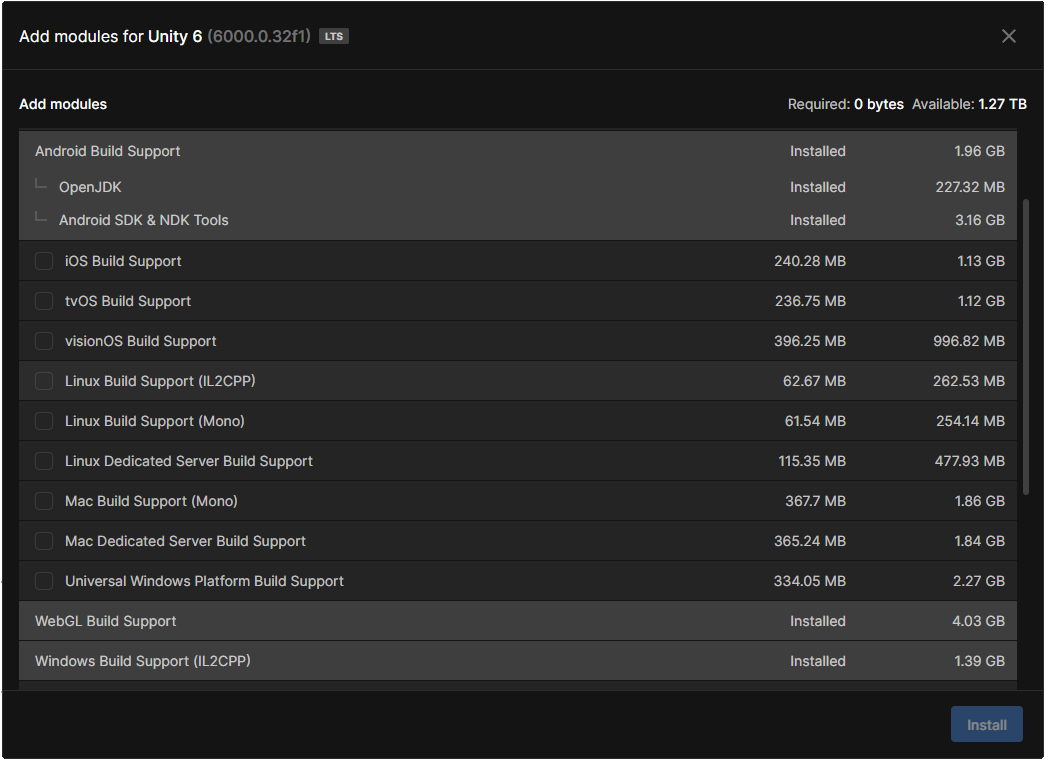
If you install the modules later, you need to build the addressables again for generating the relevant folders.
Configuration
-
Open Unity Hub and create a new Unity project with the 3D (URP) Template
WarningIt's mandatory that the project has the URP pipeline and not HDRP, otherwise the project can't be compiled correctly and display the graphic assets.
-
On the open Unity project, go to: Edit → Project Settings → Player → Settings for Windows → Other Settings → Configuration → API compatibility level → .NET Framework
-
Import the packages from these links into the scene using the package manager, selecting the "Add package from git URL" option:
- https://github.com/AnotheRealitySrl/Reflectis-SDK.git#v12.0.0
- https://github.com/AnotheRealitySrl/Reflectis-CreatorKit-Worlds-Core.git#v4.0.0
- https://github.com/AnotheRealitySrl/Reflectis-CreatorKit-Worlds-Placeholders.git#v1.0.0
- https://github.com/AnotheRealitySrl/Reflectis-CreatorKit-Worlds-VisualScripting.git#v1.0.0
Now the project has all the necessary packages to start using the Reflectis SDK.
Import 3D elements into the scene and give them new logic!